WalletThat vs WalletWallet API
A side-by-side comparison of WalletThat and WalletWallet for digital wallet pass generation in 2026, with verified pricing, a feature matrix, code samples, and an even-handed pick guide.
WalletThat is a digital wallet pass platform built by Skycore LLC, a mobile-marketing company operating since 2004. It supports Apple Wallet and Google Wallet from one dashboard, ships pass updates, push notifications, analytics, Zapier and email integrations, an Apple Watch pass surface, and a JSON API alongside the dashboard. If you want a single vendor to handle design, distribution, and ongoing management of wallet passes, with non-developers touching it too, WalletThat is a serious, well-rounded product.
WalletWallet is a REST API for Apple Wallet passes, served sub-200ms from Cloudflare’s global edge. POST creates a signed .pkpass; PUT updates it and pushes the refresh. One call also issues a native Google Wallet pass. $39/month flat, with no Apple Developer account needed.
This page is here to help you figure out which one is right for your project. Where WalletThat is the better pick, we say so.
Summary
WalletThat is a full-lifecycle wallet platform covering design, issue, update, push, scan, and analyze across both Apple Wallet and Google Wallet. The Business plan starts at $99/month + $0.01 per active Pass Record, and you bring your own Apple Developer account ($99/year). Enterprise starts at $1,000/month.
WalletWallet is a REST API for Apple Wallet passes, served sub-200ms from Cloudflare’s global edge. One POST issues to both wallets; PUT updates and pushes to both (APNs for Apple, server push for Google). $39/month flat for up to 100,000 passes, with 1,000/mo free indefinitely. We sign with our certificate, so there’s no Apple Developer account to set up.
At 100,000 active passes, the math is roughly $1,107/month on WalletThat versus $39/month on WalletWallet, a gap of about $1,068/month. WalletThat ships an analytics dashboard, scheduled bulk updates, and email-marketing connectors that we don’t. Apple and Google Wallet pass updates and push are on both sides, and so is CSV batch import. Whether the gap is worth it for you depends on which side of that list you sit on.
What WalletThat is
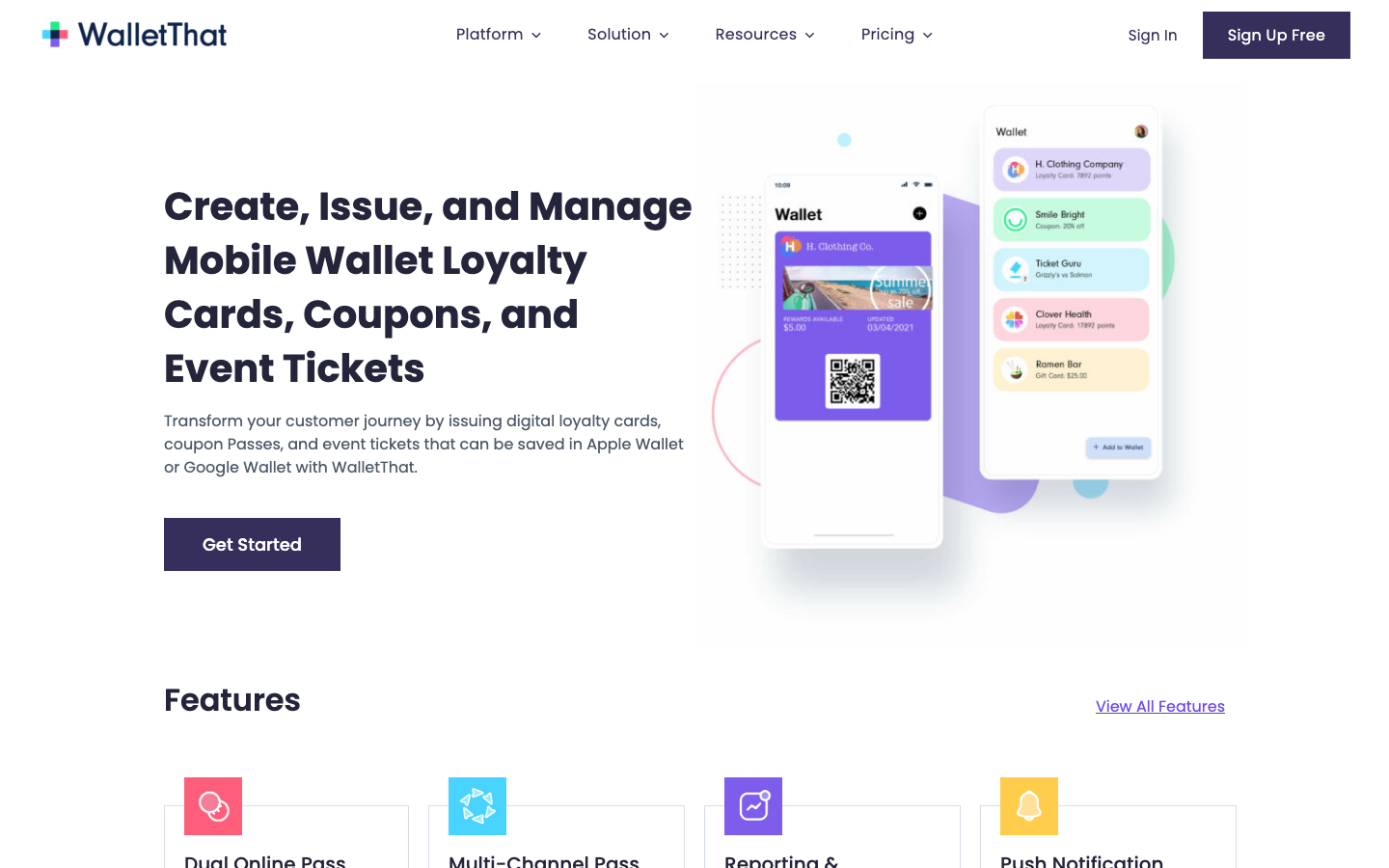
WalletThat is a mobile-wallet pass platform aimed at marketing and operations teams running loyalty cards, coupons, gift cards, event tickets, and boarding passes. From the homepage, the headline capability is the “Dual Online Pass Designer,” letting you design once and ship to both Apple Wallet and Google Wallet from one template.
The integration surface is broad: JSON API, webhooks, Zapier, and email-marketing connectors for MailChimp, Constant Contact, Klaviyo, Mailjet, and MailerLite. Pass updates can run individually or as scheduled bulk jobs; CSV import/export is built in. Pass distribution can go via universal issuance links, email, SMS, QR codes, web forms, or social media.
For commercial use, WalletThat customers bring their own Apple Developer account. The pricing page is explicit: “An Apple Developer Account ($99/year) is separately required to generate signing certificates.” There’s a $500 white-glove setup add-on if you’d rather have them handle the Apple cert and Google Merchant configuration.
What WalletWallet is
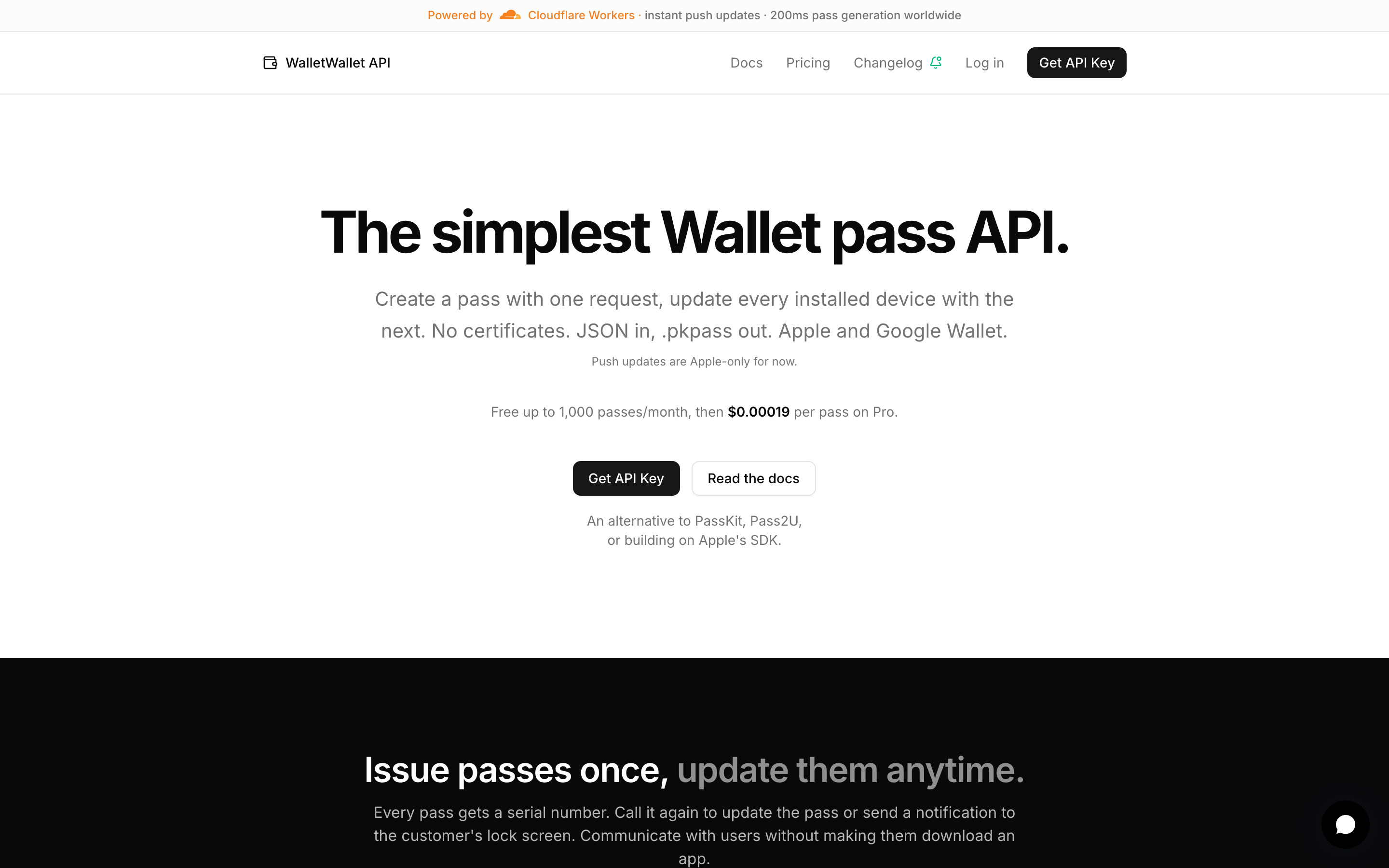
WalletWallet is a REST API for Apple Wallet passes, served from Cloudflare’s global edge. Two write endpoints (POST, PUT), one read endpoint, no template or project state on our side.
- Apple Wallet, fully.
POST /api/passescreates a signed pass and returns itsserialNumber.PUT /api/passes/{serial}updates the pass and fans out an APNs push to every installed device. Identical bodies are free no-ops. - Native Google Wallet. One call mints a real Google Wallet object and returns a Save to Google Wallet link, so one API call lands a pass in both wallets.
PUTpushes updates to Google too (server push), not just Apple. - Fast and cheap. Sub-200ms pass generation and instant push, served from Cloudflare’s co-located global edge. $39/mo flat for up to 100,000 passes, with 1,000/mo free indefinitely. No Apple Developer account required, because we sign with our certificate.
- Everything a pass needs: geofencing (up to 10
locationssurface the pass on the lock screen near a coordinate), barcode formats (QR,PDF417,Aztec,Code128),expirationDays, six color presets free plus custom hex on Pro, brand assets (logoURL/thumbnailURL/stripURL/iconURL),changeMessagetemplates for lock-screen banners,organizationNameas the notification title. See/llms.txtfor the full list. - Start simple, stay simple. The Pass Editor on the homepage previews every pass change live, including push updates. Tune the fields, colors, and images, watch the pass update, then copy the equivalent code and run it. The dashboard editor handles signed-in push-to-installed-passes too.
- Agent-ready docs. Point Claude or any LLM at
/llms.txtand it knows how to call the API. - Usable by non-developers. The Pass Editor doesn’t require writing code to design or test a pass.
Side-by-side code
WalletThat’s API is action-based JSON. You create a pass template first (in the dashboard or via the API), then POST a JSON body with an action field and a pass-template-id:
POST <your account's API URL>
X-Api-Key: <your-key>
Content-Type: application/json

{
  "action": "generatepass",
  "pass-template-id": "xxxxxxxxxxxxxxxxxxxxxxxxxxxxxxxx",
  "pass-id": "Loyalty Card_1",
  "pass-data": {
    "barcode-value": "ASDE96325",
    "loyalty-points": "65",
    "account-name": "Asian Store"
  }
}
The action determines the operation: generatepass, updatepassdata, getpassdata, getpasstemplate, createPassTemplate, and so on. The response is JSON with a pass installation URL the user opens on their device.
WalletWallet is one call. The response body is the .pkpass file:
curl -X POST https://api.walletwallet.dev/api/passes?format=pkpass \
  -H "Authorization: Bearer ww_live_..." \
  -H "Content-Type: application/json" \
  -d '{
    "barcodeValue": "MEMBER-12345",
    "barcodeFormat": "QR",
    "logoText": "Loyalty Card",
    "primaryFields": [{"label": "BALANCE", "value": "$42.50"}],
    "secondaryFields": [{"label": "MEMBER", "value": "Sarah K."}]
  }' \
  --output member.pkpass
You serve the file however you like, whether as an email attachment, an “Add to Apple Wallet” button on a page, or a download link.
Both shapes are valid. WalletThat’s template-and-action model centralizes pass state on their side, which is what makes pass updates and bulk operations easy. WalletWallet’s stateless model is simpler when each pass is independent and you keep your own data on your side.
Pricing at common volumes
We pulled the WalletThat rate card on 2026-05-20 from their public pricing page. The Business plan is “$99 monthly” plus “$0.01 per Pass Record”. The pricing page notes that “Only active Pass Records are billed,” since expired passes archive automatically, so the meter is on the active set, not on cumulative issued.
To compare fairly, we include WalletThat’s required Apple Developer account ($99/year ≈ $8.25/month amortized) in the totals. WalletWallet doesn’t need it.
| Active passes / mo | WalletThat Business + Apple Dev | WalletWallet |
|---|---|---|
| 50 | $0 (Developer plan, 30-day trial) | $0 (free tier) |
| 1,000 | $99 + $10 + $8.25 = $117.25 | $0 (free tier) |
| 10,000 | $99 + $100 + $8.25 = $207.25 | $39.00 |
| 100,000 | $99 + $1,000 + $8.25 = $1,107.25 | $39.00 |
| 500,000 | $99 + $5,000 + $8.25 = $5,107.25 | $99.00 |
| 1,000,000 | Enterprise (contact sales, starts at $1,000/mo base) | $99.00 |
A few notes on the math:
- WalletWallet’s free tier is indefinite at 1,000 passes/month. WalletThat’s Developer plan caps at 50 Pass Records and, per their pricing page, is a 30-day trial. That’s a real difference if you’re evaluating before committing.
- The $0.01 fee is the headline driver above ~5,000 active passes. At 100,000 active passes you’re paying about $1,000/mo in usage alone, on top of the $99 base, even before the Apple Developer fee.
- WalletWallet’s Business plan covers 1,000,000 passes a month for $99 flat, with no per-pass fee on top.
- The Enterprise tier ($1,000/mo) and the $500 White-Glove Setup are real options on WalletThat for teams that want hands-on onboarding, custom domains, ACH or wire payment, or net payment terms. They’re not gimmicks.
Scheduled bulk updates and an analytics dashboard are on WalletThat’s side and not ours. Apple and Google Wallet pass updates and push are on both sides, as is CSV batch import, so those aren’t WalletThat exclusives.
What WalletWallet doesn’t do (yet)
We try to be upfront about this on every comparison page. Compared to WalletThat, WalletWallet today:
- Does not run scheduled bulk updates. WalletThat schedules bulk update jobs across an existing pass set. Our Batch import creates a batch of passes from a CSV, but it does not update or revoke in bulk, so updates are per-pass
PUTcalls that you’d loop in your own job runner. - Does not support NFC. WalletThat doesn’t list NFC on their public features page either (we couldn’t confirm it as a WalletThat capability), so this isn’t a comparison point so much as a shared gap.
- Does not provide an analytics dashboard. No install, uninstall, redemption, or click tracking on our side. WalletThat ships all of that.
- Does not provide multi-user team workflows. We ship a Pass Editor in the dashboard for single-user pass design and push updates, plus Batch import for creating passes from a CSV; WalletThat’s dashboard adds CSV export, bulk scheduled updates, and multi-user collaboration.
If any of these are blocking, WalletThat is the better pick. We’d rather you find out from this page than mid-implementation.
Feature comparison
| WalletThat | WalletWallet | |
|---|---|---|
| Apple Wallet pass generation | ✓ | ✓ |
| Google Wallet support | ✓ | ✓ |
| Pass updates (Apple Wallet) | ✓ | ✓ (PUT /api/passes/{serial}) |
| Push notifications (Apple Wallet) | ✓ | ✓ (APNs fan-out on every PUT) |
| Pass updates / push on Google Wallet | ✓ | ✓ |
| NFC (Apple VAS / Google SmartTap) | not listed | — |
| No-code Pass Editor | ✓ | ✓ (homepage + dashboard) |
| Analytics dashboard | ✓ | — |
| Webhooks | ✓ | — |
| Zapier integration | ✓ | — |
| Email-marketing integrations | ✓ (MailChimp, Klaviyo, Constant Contact, Mailjet, MailerLite) | — |
| Bulk CSV import | ✓ | ✓ (dashboard, CSV upload) |
| Scheduled bulk updates | ✓ | — |
| Apple Watch pass surface | ✓ | ✓ (all PassKit passes) |
| Apple cert handling | customer brings own ($99/yr Apple) | platform handles |
| API model | action-based JSON, template-required | POST + PUT, stateless |
| Free tier | 30-day trial (50 passes) | 1,000 passes/mo, indefinite |
| Pricing model | $99/mo + $0.01 per active pass | flat plans ($39 to 100K, $99 to 1M) |
| Public pricing | yes | yes |
| Edge / global delivery | not stated | Cloudflare Workers |
When WalletThat is the better pick
- You have a marketing or ops team that wants a dashboard. Bulk updates, scheduled jobs, and email-integration setup are first-class workflows in WalletThat and non-existent in WalletWallet. We ship CSV batch import for creating passes, but not the scheduled-update side of it.
- You want analytics on installs, uninstalls, and redemption. WalletThat ships pass installation reporting and statistics out of the box. We don’t.
- You want help with the Apple cert setup. WalletThat’s $500 White-Glove Setup handles the Apple Wallet certificate, Google Merchant configuration, template design, and onboarding. If you’d rather not learn that flow at all, that’s a reasonable buy.
- You have an existing Skycore relationship or want a mature parent. WalletThat is backed by Skycore LLC, operating since 2004. If procurement cares about vendor maturity, that matters.
When WalletWallet is the better pick
- You want the fastest pass generation and push. Sub-200ms generation from Cloudflare’s co-located global edge, with APNs push landing on every installed device within seconds. Most competitors don’t publish latency numbers, and we do.
- You want a live preview before writing any code. The Pass Editor on our homepage previews every pass change (fields, colors, images, push), and the dashboard editor sends real push updates to installed passes after signup. Copy the equivalent code when you’re ready.
- You want agent-ready docs. Point Claude or any LLM at
/llms.txtand it can call the API end-to-end. No SDK plumbing needed; the docs are designed for both humans and agents. - Non-developers on your team will touch this too. The Pass Editor doesn’t require writing code to design or test a pass.
- You skip the Apple Developer Program entirely. We sign with our certificate by default, so you avoid the $99/yr fee, the Pass Type ID setup, and the certificate renewal calendar.
- You only need to issue Apple Wallet passes. Loyalty cards where you store balances on your own server, business cards, membership passes, simple event tickets where the data is set at issue time. Generation-only is a real workflow, and it’s what we’re built for.
- You don’t want an Apple Developer account. WalletThat’s pricing page is explicit that you need one. WalletWallet customers don’t, because we sign with our certificate by default. Bring-your-own-cert is an option, not a requirement.
- You’re at any volume above a few thousand active passes and budget matters. This is where the curves diverge most. At 10,000 active passes the gap is about $168/month; at 100,000 it’s roughly $1,068/month. The $0.01 active-pass fee compounds.
- You want a permanent free tier. WalletWallet’s free tier covers 1,000 passes/month with no expiration. WalletThat’s Developer plan is a 30-day trial at 50 Pass Records.
- You want a one-endpoint, stateless API. JSON in,
.pkpassout, no template setup, no project, no dashboard state to keep in sync with your backend. - You’d rather hold member data in your own systems. WalletWallet handles signing and APNs push, but we don’t try to be the source of truth for member balances, tiers, or redemption. You keep that on your side and we just translate it to a signed pass.
Try it before you decide
Get a free API key for 1,000 passes/month, indefinite, no card. After signup the Pass Editor in the dashboard previews every pass change live (including push updates to installed passes), so you can dial in fields, colors, and images, then copy the equivalent code and run it. Before signup the homepage Pass Editor runs the same preview live.
FAQ
Does WalletThat require an Apple Developer account?
Yes, for production use. WalletThat’s pricing page states explicitly: “An Apple Developer Account ($99/year) is separately required to generate signing certificates.” Their $500 White-Glove Setup add-on will handle the configuration for you, but the underlying Apple Developer Program membership is still on your invoice. WalletWallet signs with our platform certificate by default, so no Apple Developer account is required. Bring-your-own-cert is supported as an option.
How does WalletThat’s $0.01/pass fee work?
The Business plan is $99/month plus $0.01 per active Pass Record. The pricing page notes that “Only active Pass Records are billed,” since passes that expire archive automatically and stop counting. In practice, the meter is on your steady-state active wallet base, not on cumulative passes you’ve ever issued. At 100,000 active passes that’s about $1,000/month in usage on top of the $99 base. WalletWallet’s $39/month covers 100,000 passes flat, and the $99/month Business plan covers 1,000,000.
Is WalletThat’s free plan permanent?
No. The Developer plan caps at 50 Pass Records and is positioned as a 30-day trial, which is useful for evaluation but not for long-term low-volume operation. WalletWallet’s free tier is 1,000 passes/month with no expiration date.
Can I migrate from WalletThat to WalletWallet?
Apple and Google Wallet generation, updates, and push translate cleanly. Both systems produce standard PassKit passes; the payload mapping is mechanical, and the update path maps to PUT /api/passes/{serial}. You also drop the Apple Developer Program dependency on the WalletWallet side. Flows that depend on webhooks or scheduled bulk operations don’t have equivalents on our side, so a hybrid migration (keep WalletThat for those, move pass lifecycle to us) is the realistic path.
Why would I pay WalletThat $99/month if WalletWallet is $39?
Because WalletThat ships things we don’t: an analytics dashboard, scheduled bulk updates, webhooks, Zapier, and email-marketing integrations. Apple and Google Wallet pass updates and push are on both sides, and so is CSV batch import, so those aren’t part of the gap. Whether any of the rest is worth $1,068/month at 100K passes is your call.
Does WalletWallet support Google Wallet or pass updates?
Yes, fully. One POST issues to both wallets, returning a signed .pkpass and a Save to Google Wallet link, and PUT /api/passes/{serial} updates and pushes to both (APNs for Apple, server push for Google).
Last verified 2026-05-20. WalletThat pricing and features pulled from walletthat.com/pricing, the features page, the loyalty card API help article, and the about page. If you spot something out of date, let us know, because we’d rather correct the page than have it stale.
Try WalletWallet in 60 seconds
Sign up with just an email and verification code (no card), then generate your first signed .pkpass with one curl. Free tier covers 1,000 passes/month, indefinite.